
Solar Power for Manufacturing and Distribution Centers
Big roofs. Big loads. Lower power bills.
Solar fits most warehouses, plants and distribution centers. Big flat roofs and daytime loads mean most of the power is used on site, and a battery can trim demand charges. We design and build rooftop, ground-mount and carport solar, storage and electrical upgrades across the Midwest.
Updated
Why it fits
Built for how plants and warehouses use power
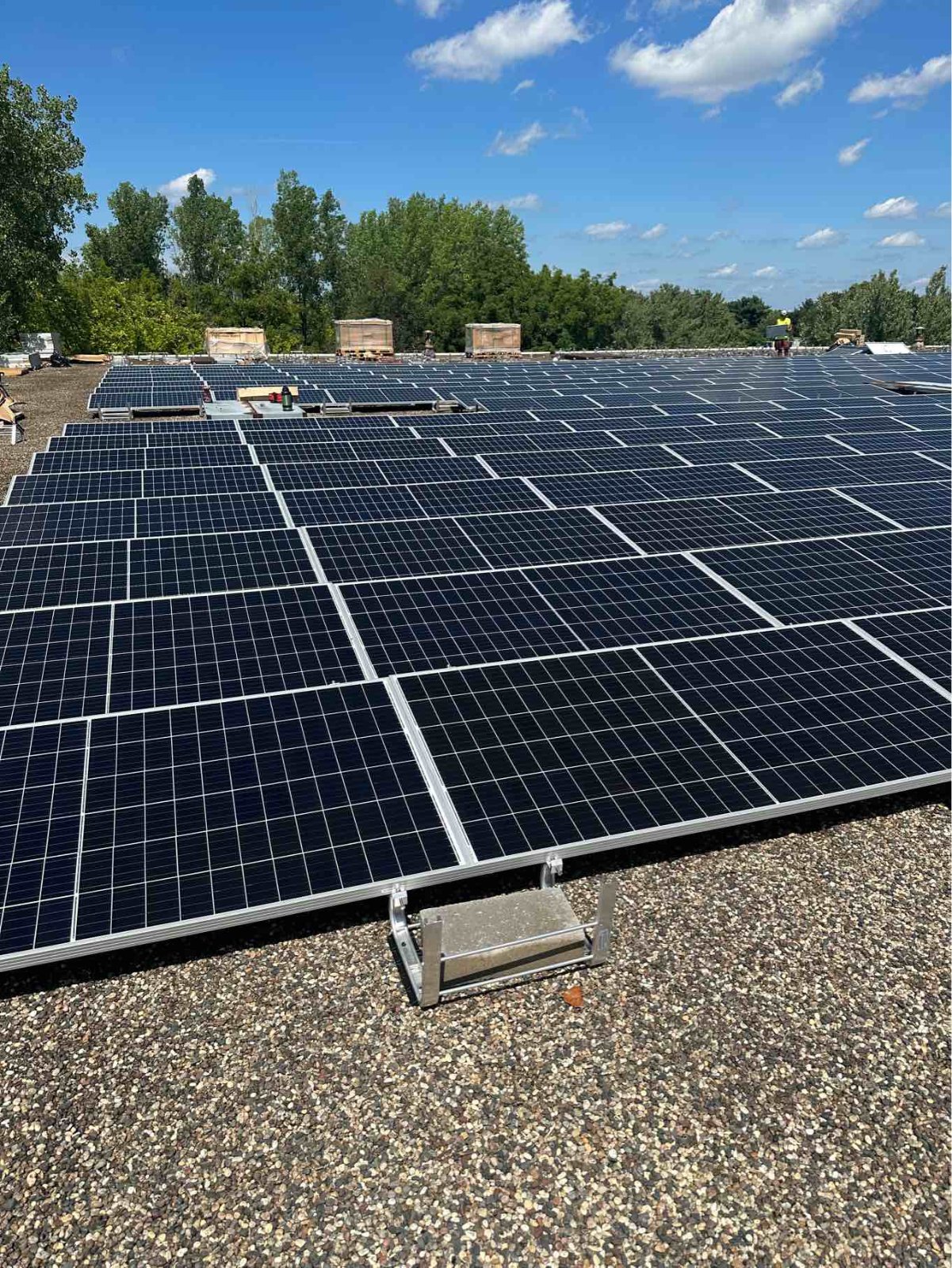
Large, flat roofs
Warehouses and plants have the roof area for large arrays, often without giving up any land.
Daytime loads
Production lines, HVAC and refrigeration run when solar produces the most power.
Demand charges
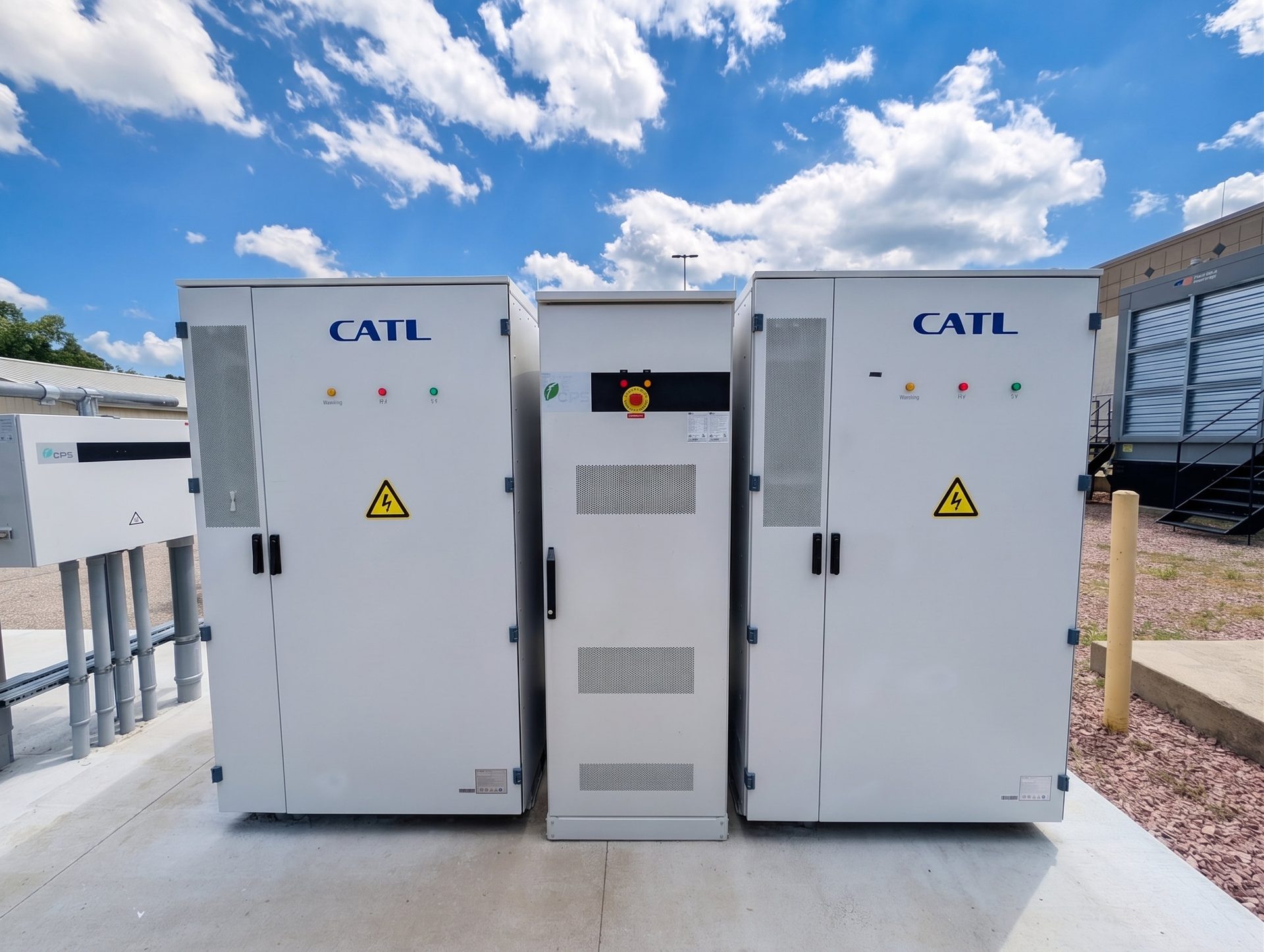
Battery storage and controls can trim the peak demand that drives many commercial bills. How peak shaving works
Backup for critical loads
Standby generators and batteries keep the equipment that cannot stop running through an outage.
Fleet and EV charging
Charging for trucks, fleet vehicles and employee parking, sized with your electrical service. Commercial EV charging
Tax value
Federal tax credits still apply to business solar placed in service by the end of 2027. Talk with your tax advisor about credits and depreciation.
What we build
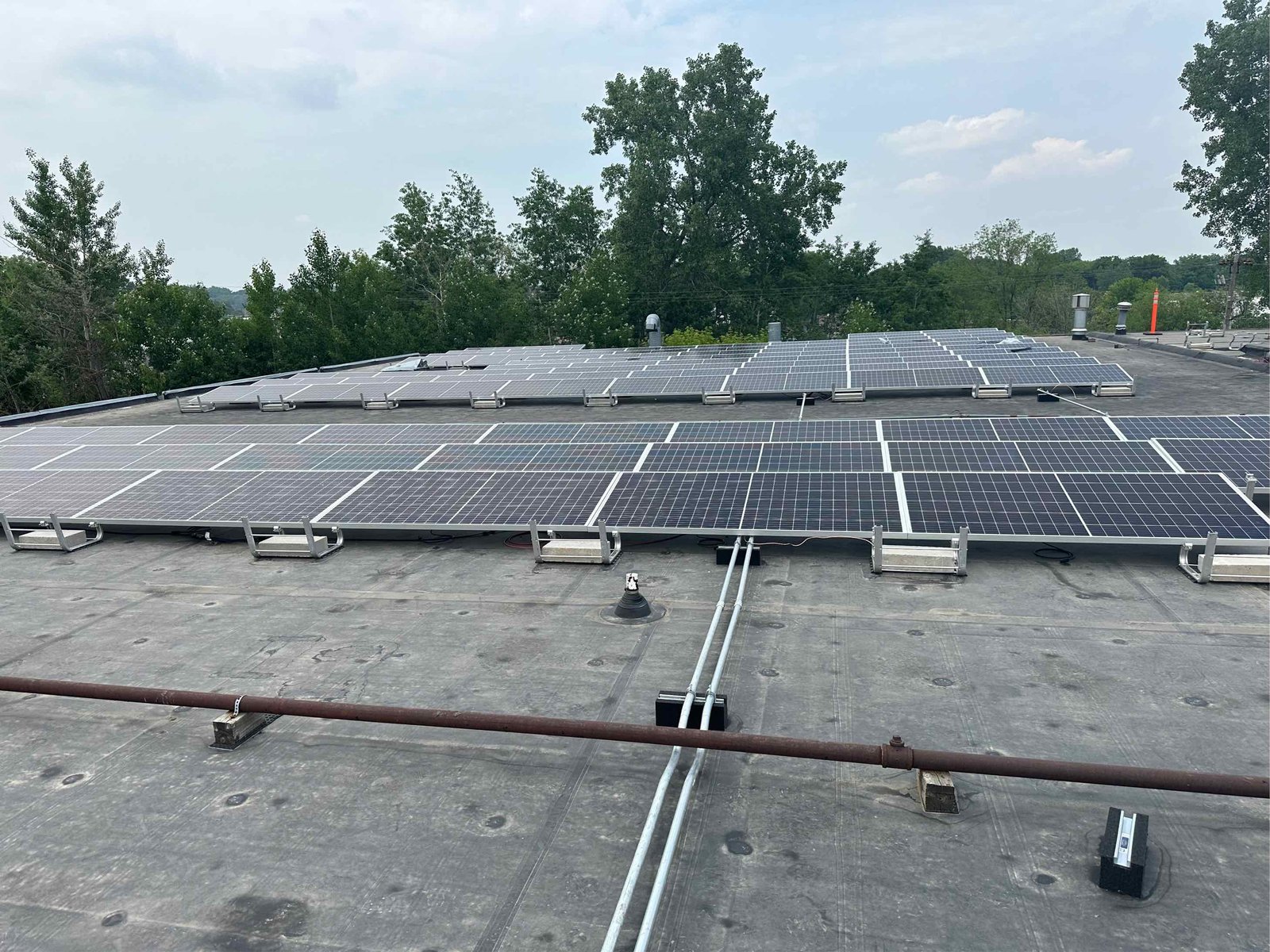
Rooftop solar
Ballasted and attached racking for flat membrane and metal roofs, planned around roof age and structure.
Ground-mount and carports
Arrays on open land next to the building, or carports that shade parking and trailers.
Battery storage
Peak shaving, load shifting and backup power, sized from your interval data.
Service and switchgear
Service upgrades, switchgear and feeders to carry new loads and new generation.
Standby generators
Generators and transfer switches for critical loads. Standby power
LED lighting
High-bay LED retrofits and controls that cut lighting load before you size solar.
How a project works
Site and bill review
We review your interval data, roof and electrical service.
Design and proposal
System size, production estimate, bill savings and storage options.
Utility and permits
Our team files the interconnection and permits.
Build and commission
Our crews build, test and energize, with shutdowns and crane lifts planned around your shifts.
Monitoring and service
We watch production and service the system for the long run.
Is solar worth it for a warehouse or plant in 2026?
For most warehouses, plants and distribution centers with steady daytime use, yes. Solar lowers the energy part of your bill, and a battery can lower the demand part. Business solar still qualifies for the 30% federal tax credit when the system is placed in service by December 31, 2027, so projects starting now should begin design and the utility application early. Before you decide, we show three numbers: your yearly bill savings, your return on net cost after incentives, and your solar cost per kWh compared with your utility rate. See commercial solar costs and timelines.
How does your load profile shape the solar system?
Your load profile shows when your building uses power across the day, the week and the year. Solar makes the most power from late morning to mid afternoon, and the most from spring through fall. The closer your use follows that curve, the more of the solar power you use on site instead of sending it to the grid.
We size from 12 months of interval data from your utility, usually 15-minute readings, not from monthly totals. Cutting load first helps too: LED high-bay lighting and controls can shrink the system you need.
How do demand charges work, and can solar lower them?
Most commercial bills have two main parts. Energy charges are for the kWh you use over the month. Demand charges are for your highest rate of use, in kW. On Xcel Energy’s Minnesota general service rate, for example, demand is billed on the highest 15-minute average in the month, and the charge per kW is higher from June through September.
Solar always lowers energy charges. It does not reliably lower demand charges, because one cloudy afternoon or one early-morning startup can set the month’s peak. A battery with controls watches your load and discharges when it nears a set limit, which trims the peak. Simple steps help as well: stagger the startup of large motors and compressors, and avoid running every charger and heater at once. Read how peak shaving works and see commercial battery storage.
What does a solar system look like for a typical warehouse?
Sample sizing, for illustration only. This is not a customer project. Take a one-shift Minnesota warehouse that uses about 600,000 kWh a year, mostly on weekdays from 7 am to 5 pm, with a monthly peak near 250 kW.
- Array size. About 250 kW on the flat roof. In Minnesota each kW of solar makes roughly 1,200 kWh a year, Minnesota Power’s estimate for the state, so this array makes about 300,000 kWh, about half of the building’s yearly use.
- Where the power goes. On weekdays nearly all of it runs the building. Weekend output goes to the grid under your utility’s rules for larger systems.
- Demand. The array alone will not hold down a 250 kW peak on a dark winter morning. A battery sized for the top 15-minute peaks, plus staggered startups, handles that part of the bill.
- Timeline. Most commercial projects take 3 to 12 months from signed contract to turn-on. Construction itself usually takes days to a few weeks.
Your own numbers come from your interval data, your roof and your electrical service. Request a site assessment.
Which incentives apply to business solar in 2026?
- 30% federal tax credit. Business solar placed in service by December 31, 2027 still qualifies. Projects that began construction by July 4, 2026 have more time. New sourcing rules limit equipment from certain foreign entities, so equipment choice matters.
- Battery storage. Storage has a longer phase-out and is not tied to the 2027 solar deadline.
- Depreciation. Ask your tax advisor how depreciation applies to the system for your business.
- Minnesota. Solar equipment is exempt from sales tax, and solar is excluded from property tax.
- Financing. Cash, loans, leases, power purchase agreements and, in many Minnesota counties, PACE financing.
Rules change, and your tax advisor confirms how credits apply to your business. See commercial solar for costs, timelines and financing, or commercial electrical construction for service and switchgear work.
Manufacturing solar questions
Will solar work on our roof?
Most flat and metal warehouse roofs can carry solar. We review roof age, structure and layout first, and plan around any roof replacement.
Can we keep running during installation?
Yes. We plan crane lifts, electrical tie-ins and any shutdowns around your production schedule.
What about demand charges?
Solar lowers the energy you buy. Battery storage and controls can also lower peak demand, which drives a large share of many commercial bills.
Learn more
Manufacturing solar: details and FAQs
Solar Power for Manufacturing and Distribution Centers
If you own or operate a distribution center, logistics hub, freight facility, or manufacturing plant, investing in commercial solar energy is one of the most effective ways to reduce overhead, increase profit margins, and power future growth. At Wolf River Electric, we deliver high-performance solar power for manufacturing, distribution, and transportation-focused operations across Minnesota, Wisconsin, Iowa, North Dakota, and South Dakota customized to meet your facility’s unique energy needs.
Many solar-powered logistics centers have expansive, flat rooftops and maintain consistent daytime energy usage, making them ideal candidates for rooftop solar panel installations. With utility rates on the rise and sustainability expectations growing from both clients and partners, switching to solar power for logistics centers helps your business stay competitive, resilient, and profitable.
Business solar can still use the 30% federal tax credit when the system is placed in service by the end of 2027, and leases, power purchase agreements and PACE financing can spread the cost. Panels carry long manufacturer warranties, so your business can benefit from decades of energy savings, steadier costs and more control over operations.
Plus, if your fleet includes electric or hybrid vehicles, your solar system can help power your freight facility operations directly, further reducing fuel costs and carbon emissions. Let Wolf River Electric help you turn your roof into a revenue-generating asset with a commercial solar solution built for distribution and logistics.
Power Reliability + Sustainability in Industrial Spaces
From precision manufacturing facilities to large-scale storage and distribution centers, industrial operations require uninterrupted power. Solar power for manufacturers, especially when paired with battery storage, provides a reliable, grid-independent solution that minimizes disruptions and boosts operational resilience.
But solar isn’t just about saving money: it’s about future-proofing your business. More and more B2B partners and major retailers now prioritize sustainable supply chain practices. Installing solar power for freight facilities or manufacturing spaces demonstrates leadership, supports ESG goals, and improves your brand image with both partners and customers.
Solar Power Solutions Tailored for Logistics, Freight & Manufacturing Facilities
Implementing solar power for logistics centers, freight facilities, and manufacturing plants requires specialized knowledge of industrial infrastructure. At Wolf River Electric, we design and install custom solar systems that align with the unique structural and operational needs of high-demand commercial environments.
Whether you’re outfitting a solar-powered logistics center with rooftop panels, utilizing open land near a manufacturing facility for ground mounts, or maximizing canopy space in a distribution hub, we engineer every system for optimal efficiency, durability, and ROI. Our expert team collaborates with your operations managers to ensure seamless integration, no matter the building type or energy load.
From feasibility studies and energy audits to permitting, installation, utility coordination, and system monitoring, we manage every phase of your solar power for manufacturing or freight operations: on schedule, on budget, and with minimal interruption to your business.
Partner with the Midwest’s Commercial Solar Experts
Manufacturing plants, warehouses, and distribution centers are among the most energy-intensive commercial facilities in the Midwest. From powering heavy-duty equipment and robotics to maintaining temperature-controlled storage and 24/7 operations, industrial buildings face enormous and often unpredictable utility costs. That’s why more facility managers and business owners are turning to commercial solar energy systems to reduce overhead, boost energy resilience, and improve sustainability.
At Wolf River Electric, we specialize in designing and installing industrial solar power systems built specifically for high-demand environments. We serve manufacturing and logistics companies across Minnesota, Wisconsin, Iowa, Illinois, Michigan, Colorado, North Dakota, and South Dakota, delivering turnkey commercial solar installations that lower energy bills, offset carbon emissions, and improve long-term operating margins. Whether you’re retrofitting an existing warehouse or integrating solar into new construction, we provide clean, scalable solar energy solutions tailored to the unique needs of industrial and commercial buildings.
Manufacturing plants, warehouses, logistics centers, and freight facilities are among the most energy-intensive commercial facilities in the Midwest. From powering heavy-duty equipment and robotics to maintaining temperature-controlled storage and 24/7 operations, industrial buildings face enormous and often unpredictable utility costs. That’s why more facility managers and business owners are turning to solar power for manufacturers and solar power for logistics centers to reduce overhead, boost energy resilience, and improve sustainability.
At Wolf River Electric, we specialize in designing and installing solar power for manufacturing and distribution environments. We serve manufacturing and logistics companies across Minnesota, Wisconsin, Iowa, Illinois, Michigan, Colorado, North Dakota, and South Dakota, delivering turnkey commercial solar installations that lower energy bills, offset carbon emissions, and improve long-term operating margins. Whether you’re retrofitting an existing warehouse or integrating solar into new construction, we provide clean, scalable solar power for distribution and industrial facilities, designed for your needs.
FAQ: Solar Power for Manufacturing & Distribution
Solar power offers manufacturing and distribution businesses a cost-effective way to reduce energy expenses and meet sustainability goals. In this FAQ, we address key questions about installation, benefits, and ROI.
Can Solar Panels Reduce Costs for Distribution Centers and Manufacturers?
Yes, solar panels can significantly reduce costs for distribution centers and manufacturers. By generating renewable energy on-site, businesses can lower their utility bills, mitigate reliance on fluctuating grid electricity prices, and potentially benefit from tax incentives and rebates. Additionally, solar energy can provide long-term savings by decreasing operational expenses and increasing energy efficiency over time.
What is the importance of solar energy for manufacturing and distribution businesses in the Midwest?
Solar energy is crucial for manufacturing and distribution businesses in the Midwest due to rising energy costs, sustainability goals, and the region’s relatively high solar energy potential compared to its energy needs. It allows businesses to reduce carbon footprints, improve energy resilience, and align with government incentives for renewable energy adoption. Moreover, it contributes to long-term cost savings while enhancing environmental responsibility, particularly in states where manufacturing plays a significant economic role.
Can Wolf River Electric Design and Install Solar Power Systems for Large Scale Manufacturers or distribution centers?
Yes, Wolf River Electric has the expertise to design and install solar power systems for large-scale manufacturers and distribution centers. They specialize in crafting customized solutions to meet specific energy needs, ensuring systems are optimized for peak performance and cost-effectiveness. Their team manages the entire process, from design to installation, making it easier for businesses to transition to solar energy while meeting compliance and efficiency standards.
Take Charge of Your Energy Future with Commercial Solar
If you’re ready to reduce operational expenses, increase energy efficiency, and make your facility more sustainable, now is the time to invest in commercial solar energy. Whether you’re managing a busy manufacturing plant in Minnesota, a warehouse in Wisconsin, a distribution center in Iowa, or an industrial freight facility in North Dakota or South Dakota, Wolf River Electric is your trusted partner for custom-designed solar systems that perform, today and for decades to come.
We offer full-service, turnkey solar solutions: from site assessments and engineering to permitting, installation, and ongoing performance monitoring. With access to federal tax incentives, state and utility rebates, and flexible financing options, we make it easier than ever to implement solar power for freight facilities, logistics operations, or manufacturing environments, without the upfront burden.
Ready to Take the First Step? Contact Wolf River Electric today for a free consultation. Let us show you how clean, affordable, and reliable energy can transform your business operations across the Midwest. Reduce energy costs. Increase operational control. Lead your industry with Wolf River Electric, serving Minnesota, Wisconsin, Iowa, North Dakota, and South Dakota with expert solar power for manufacturing, distribution, and logistics centers.