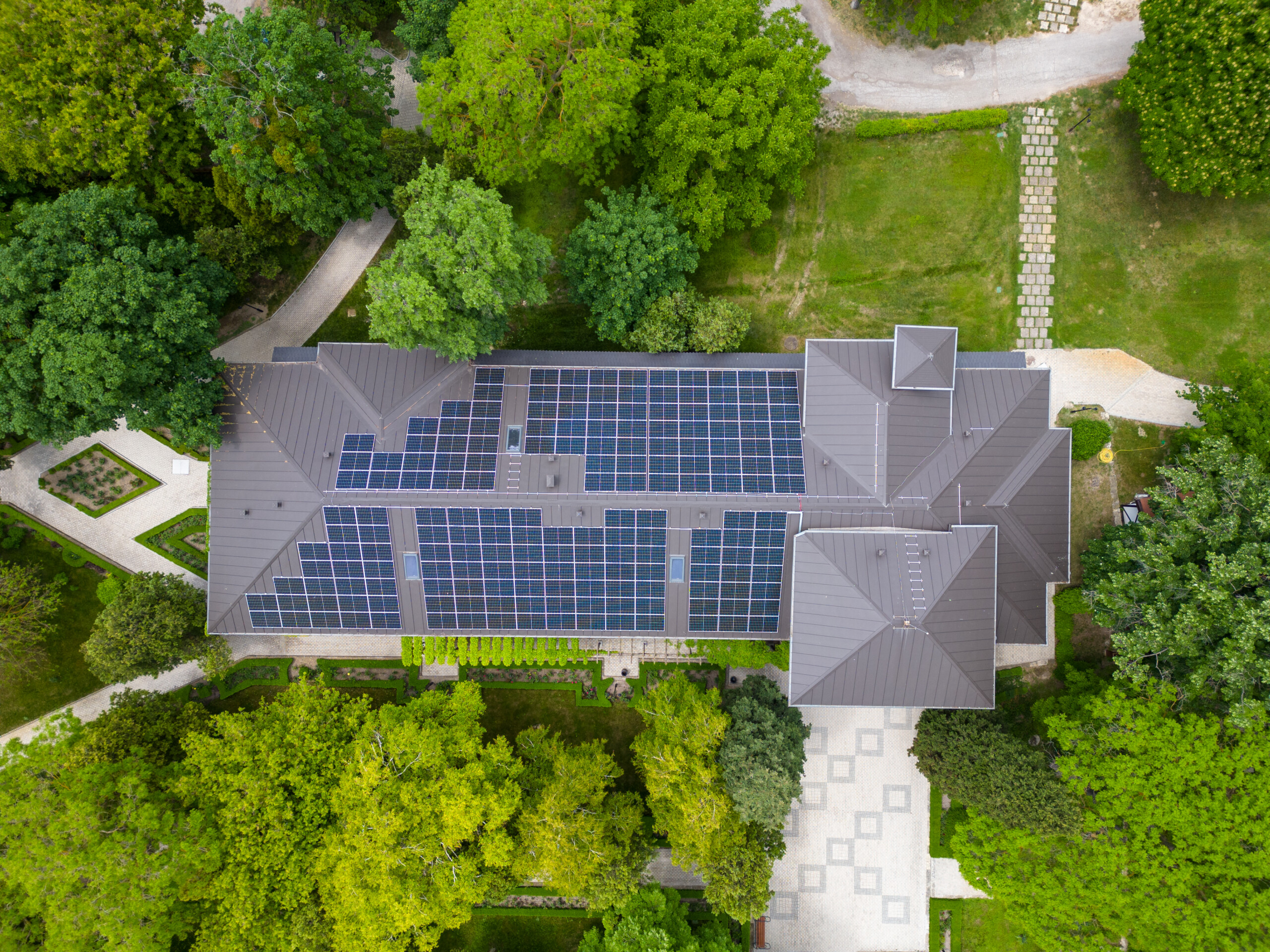
Quick answer: A single residential solar panel produces between 350 and 450 watts under peak conditions and roughly 1.2 to 1.6 kWh of electricity per day on average. A typical home system generates 800 to 1,200 kWh per month — enough to cover most or all of a Midwest household’s electricity needs.
All production figures in this article are estimates. Your actual output will vary based on your roof orientation, shading, and system design. Contact Wolf River Electric for a precise assessment of your home.
What Does “Solar Panel Output” Actually Mean?
When people ask how much power a solar panel produces, they’re usually asking two slightly different questions, and both matter.
Wattage (W) is how much power a panel generates at any given moment under peak sunlight.
Kilowatt-hours (kWh)is how much total energy a panel produces over a day, month, or year.
Think of it this way: wattage is like the speed of a car, and kilowatt-hours are the total miles driven. For understanding your electric bill, kilowatt-hours are what matter. Your utility measures and charges you in kWh.
How Much Power Does a Single Solar Panel Produce?
Most modern residential solar panels are rated between 350 and 450 watts. Under standard test conditions, direct midday sun at 77°F, a 400-watt panel produces 400 watt-hours for every hour it runs at full capacity.
In real-world conditions across Minnesota, Wisconsin, Iowa, North Dakota, and South Dakota, that same 400W panel typically produces around 1.2 to 1.6 kWh per day, 36 to 48 kWh per month, and 440 to 580 kWh over a full year. Those figures are based on the 3.5 to 4.0 peak sun hours per day that the upper Midwest receives on average, according to the NLR PVWatts Calculator — the industry-standard tool for estimating solar production by location.
What Type of Solar Panel Produces the Most Power?
There are a few main types of residential solar panels, and they’re not all equal when it comes to output.
Monocrystalline panels (370–450W, 20–23% efficiency) are what Wolf River Electric installs on most homes. They produce the most power per square foot, which matters when roof space is limited.
Bifacial panels (400–500W, 21–24% efficiency) are similar in efficiency but capture sunlight from both sides of the panel, making them a great option for light-colored roofs or ground-mounted systems.
Polycrystalline panels (280–360W, 15–17% efficiency) are a lower-cost option that works well when roof space isn’t a constraint, though they produce less power from the same area.
Thin-film panels (150–200W, 10–13% efficiency) are mainly used in commercial and flat-roof applications rather than residential installs.
For most Midwest homeowners, monocrystalline or bifacial panels are the right choice, and they’re what Wolf River Electric primarily installs. Efficiency ranges are sourced from NLR PVWatts v8 and current manufacturer specifications.
How Much Does a Full Home Solar System Produce?
A single panel is just one piece of the puzzle. Most residential systems range from 8 to 12 kilowatts, depending on the size of the home and how much of the electric bill the homeowner wants to offset.
A smaller 5 kW system with 12 to 14 panels typically produces 500 to 600 kWh per month, enough for a smaller home or a household with modest energy use. An 8 kW system with 18 to 22 panels hits 800 to 960 kWh per month, which is right-sized for the average Midwest household. Larger homes or households with electric vehicles often go with a 10 to 12 kW system, which can produce 1,000 to 1,440 kWh per month.
For context, the U.S. Energy Information Administration reports that the average U.S. household used approximately 865 kWh per month in 2024. Most homes in Minnesota, Wisconsin, and Iowa fall right in that range, making an 8 to 10 kW system a solid starting point.
6 Things That Affect How Much Power Your Panels Produce
1. Where You Live
The Midwest gets between 3.5 and 4.5 peak sun hours per day annually, less than Arizona, but more than the Pacific Northwest, and more than enough for solar to make strong financial sense. Minnesota, Wisconsin, and Iowa all average around 4.0 peak sun hours.
Minnesota homeowners also benefit from a strong net metering policy, meaning excess power you produce in summer gets credited against your winter bills, making seasonal swings in production much less of a concern.
2. Which Direction Your Roof Faces
South-facing roofs at a 30 to 40 degree pitch produce the most power year-round. East- or west-facing roofs generate about 15 to 20 percent less, but are still very worth installing on. North-facing sections are generally avoided. Wolf River Electric’s team performs a full roof assessment before designing any system, so panels end up exactly where they’ll perform best.
3. Shading
Even a small amount of shading from a chimney, a nearby tree, or a neighboring building can meaningfully reduce output. The good news is that modern microinverters and power optimizers allow each panel to operate independently, so one shaded panel doesn’t drag the whole system down. This is one of the most important reasons to work with an experienced installer: shading decisions made at install time affect your output for the next 25 years.
4. Panel Quality and Efficiency
A higher-efficiency panel produces more power from the same amount of roof space. The difference is significant; a 22% efficient panel generates roughly 30% more electricity than a 17% efficient panel of the same physical size. When roof space is tight, panel efficiency is one of the most important numbers to compare.
5. Temperature
Solar panels are tested at 77°F, and output actually decreases slightly above that, about 0.3 to 0.5 percent per degree Fahrenheit. That means Minnesota’s cooler climate is a mild advantage over the Sun Belt, where summer heat regularly trims panel output.
6. Age and Degradation Over Time
Panels lose roughly 0.5 percent of their output capacity per year. A panel installed today will still produce about 90 percent of its original output after 20 years, and most quality panels come with 25-year production warranties to back that up. For a deeper look at lifespan expectations, see our guide on how long solar panels last.
How Much Power Does Solar Produce in Minnesota, Wisconsin, and Iowa?
The Midwest gets a better solar resource than most people expect. Using a standard 10 kW system as a benchmark, homes in Minneapolis and Milwaukee typically produce around 900 to 930 kWh per month on average across the year. Des Moines, Iowa, sits slightly higher at around 1,000 kWh per month due to a bit more annual sun. Rochester, MN, and Fargo, ND, fall in the 900 to 960 kWh range.
These are annual averages; summer months will be significantly higher and winter months lower. Net metering smooths out that seasonal difference by banking your summer surplus as bill credits. Figures are based on NLR PVWatts data; actual output varies based on roof specifics, shading, and system design.
How Many Solar Panels Do You Actually Need?
A simple way to estimate: take your average monthly electricity usage and divide it by what a single panel produces in your area. In Minneapolis, a 400W panel produces about 48 kWh per month. If your home uses 900 kWh per month, you’d need roughly 19 panels or about an 8 kW system.
That said, your actual number depends on your roof space, shading, how much of your bill you want to offset, and whether you’re planning to add an EV. Wolf River Electric’s free solar calculator gives you a precise estimate based on your actual address and real usage data, no guesswork required.
Pairing Solar With Battery Storage
Solar panels produce power during the day a battery lets you use that power at night or keep the lights on during an outage. The Tesla Powerwall is one of the most popular options Wolf River Electric installs, offering 13.5 kWh of usable storage per unit. For most Midwest households, pairing a 10 kW solar system with one or two Powerwalls can dramatically reduce — or eliminate — grid dependence year-round.
Frequently Asked Questions
How much power does a solar panel produce on a cloudy day?
Panels still generate electricity on cloudy days, typically 10 to 25 percent of their rated output, depending on cloud cover. Production drops, but it doesn’t stop. Most Minnesota and Wisconsin homeowners are surprised by how much their systems still produce in overcast conditions, and net metering credits from sunny months help offset any shortfall.
Can solar panels power a whole house?
Yes, in most cases. A properly sized system, typically 8 to 12 kW for a Midwest home, combined with your utility’s net metering program, can offset 80 to 100 percent of your annual electricity use. Adding battery storage extends that coverage through evenings and outages.
How much power do panels produce in Minnesota winters?
Output drops significantly in winter due to shorter days and lower sun angles. A system that produces 1,000 kWh in July might produce 300 to 400 kWh in January in Minneapolis. This is expected and factored into system sizing from the start. Net metering lets you bank surplus summer production as credits to apply against lower winter output.
What’s the difference between watts and kilowatt-hours?
Watts measure the rate of power generation at any moment. Kilowatt-hours measure total energy produced over time. A 400W panel running for 3 hours produces 1.2 kWh. Your electric bill is measured in kWh, which is why that’s the more useful number when estimating solar savings.
Ready to See What Your Home Can Produce?
Every roof is different, and the only way to know exactly what your system will generate is a proper assessment of your specific home roof orientation, shading, local sun hours, and your actual electricity usage, all factor in.
Wolf River Electric has installed solar systems for homeowners and businesses across Minnesota, Wisconsin, Iowa, North Dakota, and South Dakota. We design every system to fit your actual energy needs — not a generic template — and we’re local, licensed, and accountable for the work we do. Request your free no-obligation solar quote today.